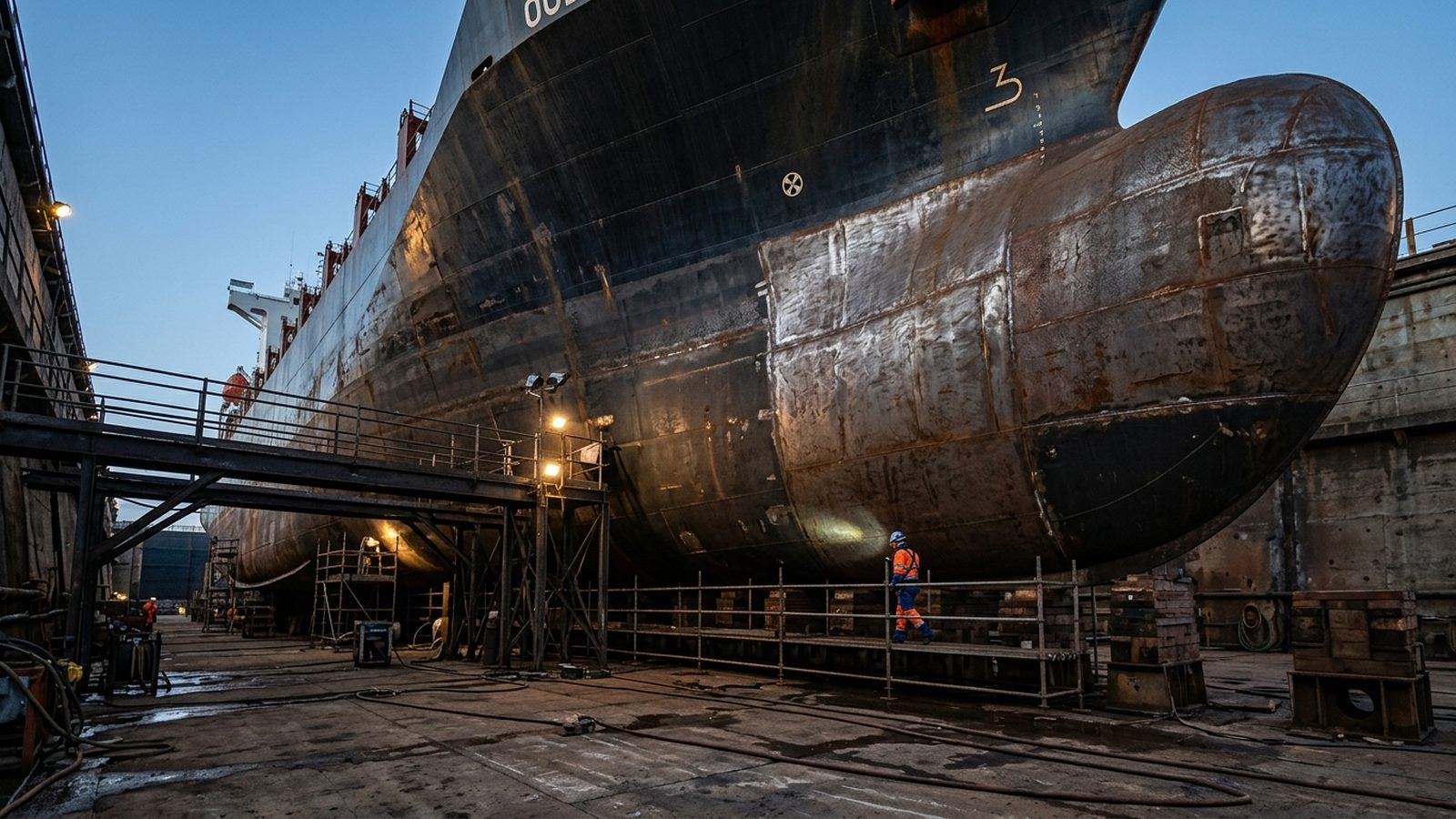
How to Prepare for a Special Survey Drydocking: A Practical Guide

Roughly 30,000 vessels in the world fleet are currently inside a special-survey window — about 5,800 approaching their first (5-year) survey, 6,300 their second, 10,500 their third and 7,400 their fourth. If your ship is one of them, the difference between a smooth docking and a budget-wrecking one is decided months before the yard period starts.
What the special survey actually covers
Every classed vessel renews its class certificate on a five-year cycle. The special survey is the heavy one: hull thickness gauging, internal tank and structure examination, sea valves and shell openings, anchoring equipment, and — commonly aligned with the same docking — tailshaft survey, propeller and rudder inspection and coating renewal. From the third special survey onward the scope expands significantly, which is why surveys 3 and 4 dominate yard time and cost.
The countdown that works
12 months out — scope and strategy
- Pull the class status report and list every survey item falling due; decide what to align into one docking.
- Review the last docking report and known steel/coating problem areas — they set the contingency budget.
- Decide the trading position for the docking window: repositioning cost often exceeds the day-rate difference between regions.
9 months out — specification and enquiry
- Write the repair specification with quantities, not adjectives ("120 m² blast and recoat, ballast tank 4P" — not "touch up as required"). Vague specs price high and change-order higher.
- Shortlist yards with a proven record for your vessel type and size — a yard that docks your class of ship weekly carries the right staging, blasting capacity and subcontractor bench. Regional market conditions matter too: the Ship Repair Index shows which regions are running hot (busy yards quote hard) and where capacity is available.
- Send the enquiry to 4–6 yards across at least two regions for honest price tension.
6 months out — compare and commit
- Normalize quotations: tariff day rates, staging, power/crane charges, gas-freeing, and the yard's change-order pricing — the headline lump sum rarely decides the real outcome.
- Check the berth/dock slot in writing against your class window, with a fallback slot agreed.
3 months out — de-risk the critical path
- Order long-lead items now: tailshaft seals, anodes, valves, coating systems. Late owner-supplied material is the most common cause of dock-day overruns.
- Book the class surveyor, service engineers (main engine, BWTS, radio survey) and any voyage-repair squads for pre-docking work.
Choosing the yard: what actually matters
Beyond price: dock availability that fits the class window, documented experience with your vessel type, subcontractor depth (blasting capacity is the classic bottleneck), and the yard's record on schedule integrity. TrustedDocks profiles show each yard's dock dimensions, facilities and — uniquely — its actual repair track record from AIS-verified vessel visits, so you can see who really docks ships like yours. Start from the global shipyard directory or the country hubs (Turkey, China, UAE), and check the PSC statistics to understand the inspection climate on your intended trade after the docking.
The one rule
Every week of preparation before the enquiry saves a day of dispute in the dock. A tight specification, honest steel estimates and early material orders beat any negotiation tactic — and they are entirely under your control.